How to Choose a Digital Lead Generation Agency
How to Choose a Digital Lead Generation Agency
 General
Hiring a digital lead generation agency can fill your sales pipeline, or it can drain your budget on enquiries nobody can close. The difference usually comes down to the questions you ask before you sign. This guide is for Irish small business owners weighing up an outside partner for the first time. It covers what these agencies deliver, how their pricing works, the questions worth asking, the red flags to avoid and who owns your contact data. If you need a primer first, our guide to what counts as a digital lead in 2026 is a good place to start.
Key Takeaways
- Judge an agency on lead quality, follow up and reporting, not on the volume of form fills it promises.
- Retainer, pay per lead and hybrid pricing each shift risk differently, so match the model to how predictable your sales cycle is.
- Your contact data should live in a system you own, with consent records you can produce on request.
What does a digital lead generation agency actually deliver?
At its simplest, the agency runs the channels that bring enquiries to your business and hands those enquiries over in a usable state. That normally means some mix of search, Google Business Profile, paid search, social campaigns, email and website forms. A good partner also builds the pages and offers those channels point to, because traffic with nowhere useful to land produces nothing.
The less visible work matters just as much. Expect tracking on every form and call, a CRM or lead list where each enquiry is logged, and agreed rules for what counts as qualified. Many agencies also write follow up emails, score leads and report on which source produced which customer. If you want to see how each channel plays its part in the funnel, that is worth understanding before you compare proposals.
What an agency should not do is close the sale for you. Your team still answers the phone, sends the quote and builds the relationship. The best arrangements make that hand off clean. Each lead arrives with its source, what the person asked for and how soon they need an answer. Ask to see a sample lead record before you sign, because it tells you more than any pitch deck.
How do retainer, pay per lead and hybrid pricing compare?
A monthly retainer pays for a defined scope of work: campaign management, content, reporting and ongoing optimisation. You carry more of the risk, because you pay whether the month is busy or quiet. In return you usually get more strategic attention. The agency also has a reason to build assets, such as pages and content, that keep working after a campaign ends.
Pay per lead flips the risk. You pay a set fee for each enquiry that meets an agreed definition. It sounds safer, but everything depends on that definition. If a lead means any form fill, you may pay for students, competitors and people outside your service area. Agencies on this model can also drift towards cheap volume, since quality does not change their fee.
Hybrid pricing combines a smaller base fee with a payment per qualified lead or per booked appointment. It suits businesses with a steady sales process and a clear picture of a good enquiry. Whatever the model, ask what drives the cost: the number of channels, content volume, CRM work and reporting depth. Ad spend itself should always be billed separately, paid into accounts you can see.
When you compare two proposals, put them on the same footing. List what each includes, who does the work, how often you will meet and what happens in the first month. A cheaper quote that leaves out tracking or landing pages often costs more once you add those back. The clearer proposal is usually the safer choice.
Which questions should you ask before you sign?
A first call with an agency should feel like a working session, not a sales presentation. Bring your own numbers: average job value, how many enquiries your team can handle in a week and which services earn the best margin. A capable agency will turn those into a plan. A weak one will talk about traffic and followers. The questions below separate the two quickly.
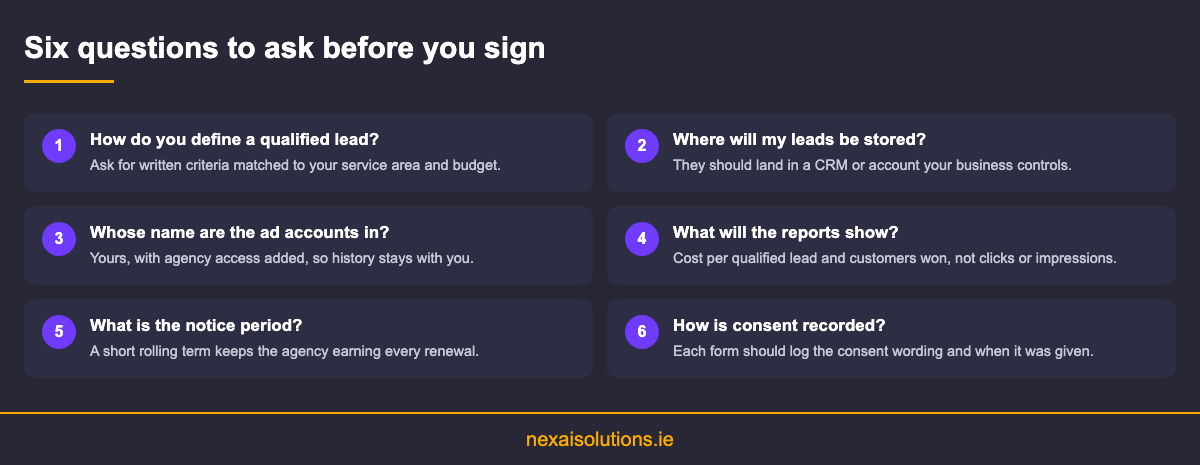
Pay close attention to how they define a qualified lead. A good answer mentions your service area, budget fit and timing, not just a valid email address. Ask how quickly leads reach your inbox and what happens when nobody picks up. You will also learn a lot by asking which of these tactics for a tight marketing budget they would test first, and why.
Finally, ask about reporting. You want to see cost per qualified lead and, ideally, which leads became paying customers. Monthly figures without that link to revenue are hard to act on. Our checklist for hiring an Irish agency covers broader vetting points such as team access and communication, so use it alongside the questions here.
What red flags should make you walk away?
A promised lead count is the clearest warning sign. No honest agency can promise a fixed number of enquiries before it has tested your market, your offer and your website. A promise like that usually means the number will be hit by lowering the quality bar. When those leads fail to convert, the agency points back to the contract.
Unclear lead ownership is the second warning sign. If leads arrive in the agency's own portal and you only see a weekly export, you lose that history the moment you leave. The same applies to ad accounts, tracking and landing pages built on the agency's own systems. Long lock in periods make this worse, because you cannot walk away when performance slips.
Be wary, too, of any agency that will not give you access to your own data, resells the same leads to competitors or cannot say where leads come from. Bought or shared contact lists are a particular risk under Irish and EU data rules. Our piece on red flags when comparing Dublin providers covers further warning signs that apply anywhere in Ireland.
None of these flags means the agency is dishonest. Some are simply habits carried over from bigger clients. Raise each one directly and ask for the change in writing. A partner worth hiring will adjust its terms, while one that refuses has told you what working together would be like.
Who owns the contact data, and how does GDPR apply?
In most arrangements, your business is the controller of the personal data collected about prospects, and the agency processes it on your behalf. That means you carry responsibility for how the data is gathered, stored and used. Ask for a data processing agreement as part of the contract. It should set out where data is held, who can access it and how it is deleted.
Consent needs particular care. Forms should explain clearly what a person is signing up for, and marketing consent should never rely on a box ticked in advance. The Data Protection Commission publishes guidance on lawful processing and consent. The ePrivacy Regulations set the rules for electronic direct marketing, including follow up by email and text.
Ownership should also be written into the contract in plain terms. Leads, consent records, ad accounts, audiences and creative should all transfer to you if the relationship ends. Keeping everything in one place makes that simple. The NexAI platform logs leads in a mini CRM alongside a unified dashboard across channels, so each enquiry and its source stay visible.
Conclusion
Choosing a digital lead generation agency is less about finding the biggest promise and more about finding the clearest terms. Look for a written definition of a qualified lead, pricing that suits your sales cycle, reporting tied to real customers and data that stays yours. If you would like a second opinion on a proposal, or want to see how an AI assisted approach could work for your business, book a free consultation with the NexAI Solutions team. We are based in Tullamore and work with businesses across Ireland.
Frequently Asked Questions
What does a digital lead generation agency do?
It runs online channels such as search, paid ads, social and email to bring enquiries to your business. It also sets up tracking, qualifies those enquiries against agreed criteria and passes them to your team to follow up and close.
Is pay per lead better than a monthly retainer?
Neither is better in every case. Pay per lead suits businesses with a tight, written definition of a qualified enquiry. A retainer suits longer sales cycles and work that builds lasting assets, such as content and landing pages.
Can an agency promise a set number of leads?
An honest agency will not commit to a fixed number before testing your market and offer. It can commit to activity, transparent reporting and a clear process for improving results. Treat any firm promise of lead volume as a warning sign.
Who owns the leads an agency generates for me?
You should. Write it into the contract that leads, consent records, ad accounts and audiences belong to your business and transfer to you in full if the relationship ends. Keep them in a CRM or account under your control.
Does my agency need to be based in Dublin?
No. Most of the work happens online, so knowledge of your market matters more than an office address. Our guide to hiring a marketing partner outside Dublin explains what to weigh up when choosing a provider elsewhere in Ireland.
How long should an agency contract run?
A short initial term followed by a rolling monthly arrangement gives you room to judge results fairly. Long lock in periods are risky, because early campaigns need testing and you want the option to leave if lead quality does not improve.
What should a monthly lead report include?
At minimum, qualified leads by source, cost per qualified lead and how many became customers. It should also flag enquiries that went unanswered. Reviewing the tools that capture and track enquiries shows what good reporting can draw on.
Do I need consent for every lead an agency collects?
You need a lawful basis for processing each person's data, and marketing by email or text usually needs consent. Ask your agency exactly how its forms record consent, and read the Data Protection Commission guidance before any campaign goes live.
Frequently Asked Questions
What does a digital lead generation agency do?

Is pay per lead better than a monthly retainer?
Can an agency promise a set number of leads?
Who owns the leads an agency generates for me?
Does my agency need to be based in Dublin?
How long should an agency contract run?
What should a monthly lead report include?
Do I need consent for every lead an agency collects?