Digital Marketing Lead Generation Strategy: 7 Tactics That Work
Digital Marketing Lead Generation Strategy: 7 Tactics That Work
 General
A digital marketing lead generation strategy does not need a big budget. It needs a short list of tactics that suit how your customers buy, done properly and measured honestly. If you are still working out how each channel feeds the funnel, start there. This guide assumes you know your channels and want to know what to do this quarter. Below are seven strategies that work for Irish small businesses with limited time and money, followed by a simple way to decide which one to start with.
Key Takeaways
- Match your pages and Google Business Profile to the exact searches buyers make before you spend on ads.
- A useful lead magnet and a fast response workflow turn more of your existing traffic into real conversations.
- When budget is tight, fix the gaps closest to the enquiry first and test one offer at a time.
Which search strategies win enquiries first?
Strategy one is to build pages that match how people search. A single services page listing everything you do rarely ranks for anything specific. A buyer searching for kitchen fitting in Mullingar wants a page about kitchen fitting that mentions Mullingar and the nearby towns you actually cover.
Give each core service its own page, and add location pages only where you genuinely work and can say something local. Each page should answer the questions buyers ask, show relevant photos or examples, and end with one clear action. Thin pages that swap a town name and repeat the same text help nobody, including you.
Before writing a word, list the questions customers ask you on the phone. Those questions are your page content, and they often match the words people type into search. Use the language your customers use rather than trade jargon, and answer price questions by explaining what drives the cost.
Strategy two is a complete Google Business Profile with call and booking actions switched on. Choose the most specific primary category, list your services, add a booking link if you take appointments, and keep your hours accurate. Post updates regularly and reply to every review. A profile that answers questions at a glance can win the call before a searcher reaches any website.
How do you turn more visitors into leads?
Strategy three is a lead magnet people actually want. A generic newsletter box rarely persuades anyone. A short checklist, a guide explaining what drives the cost of your service, or a planning template gives a visitor a real reason to share an email address.
Place the offer where it fits naturally, at the end of a relevant guide or service page, rather than in a popup that appears before anyone has read a word. One well placed offer usually outperforms several competing ones on the same page.
Ask only for what you need, say what you will send, and record consent properly. The consent basics covered in our guide to digital leads apply here, and the Data Protection Commission publishes guidance on lawful processing. A contact captured without clear consent is a liability rather than an asset.
Strategy four is a fast response workflow. An enquiry cools quickly, and the business that replies first with something useful often wins the job. Send an instant acknowledgement, route each lead to a named person, and agree a same day callback target for working hours. The NexAI platform logs each lead in a mini CRM, so nothing waits unseen in a shared inbox.
Decide in advance which enquiries deserve a call now and which belong in a nurture sequence. Our walkthrough of the full journey from capture to sale breaks down that qualification step.
How do you win back visitors and reach B2B buyers?
Strategy five is retargeting. Plenty of people visit, read and leave without enquiring. Retargeting shows them a relevant ad on Google, Facebook or Instagram in the days that follow. Keep the message specific to the page they viewed, cap how often people see it, and only track visitors who accepted cookies.
Retargeting works best with a reason to come back, such as the lead magnet from strategy three or a limited number of booking slots. The same generic brand ad shown for months mostly irritates people. Refresh the creative regularly and exclude anyone who has already enquired.
Strategy six is LinkedIn Lead Gen Forms for B2B. If you sell to other businesses, LinkedIn lets you target by job role, industry and company size. LinkedIn's own lead form options open inside the platform and prefill details from the member's profile, which removes the friction of a separate landing page. Offer something substantial, such as a practical guide or a short assessment, and follow up within the working day.
For B2B, the follow up matters as much as the form. Someone who downloads a guide on LinkedIn is curious, not necessarily ready to buy. Send what you promised straight away, then one or two genuinely useful emails before you ask for a call. Pushing for a meeting in the first message tends to end the conversation.
Why should you test one offer at a time?
Strategy seven is disciplined testing. When the ad, the page and the offer all change in the same week, you cannot tell what made the difference. Change one thing, run it long enough to gather a fair number of enquiries, then decide.
Start with the offer itself, because it usually matters more than button colours or headline tweaks. A free site survey, a fixed fee consultation, a downloadable guide and a priority booking slot each attract different people. Track enquiries and how many become paying customers, not just clicks.
Many small businesses have too little traffic for formal split testing, and that is fine. Run offers in sequence instead, one per month or per season, and compare the quality of enquiries as well as the volume. A handful of serious enquiries is worth more than a long list of price shoppers who never book.
Write each test down: what changed, the dates and the result. After a few months that log becomes one of the most valuable marketing documents you own. It shows what your customers respond to, rather than what a template assumes they want.
How do you prioritise a digital marketing lead generation strategy when budget is tight?
Start where the enquiry happens and work backwards. Fix your Google Business Profile and your core service pages first, because they serve people who are already looking. Then set up the response workflow, since there is no point paying for leads you answer late.
Only then add the strategies that cost money every month, such as retargeting and LinkedIn campaigns. Add one at a time and give each a fair trial before judging it. If you plan to bring in outside help, reading what a Dublin retainer includes will help you compare proposals on scope rather than price alone.
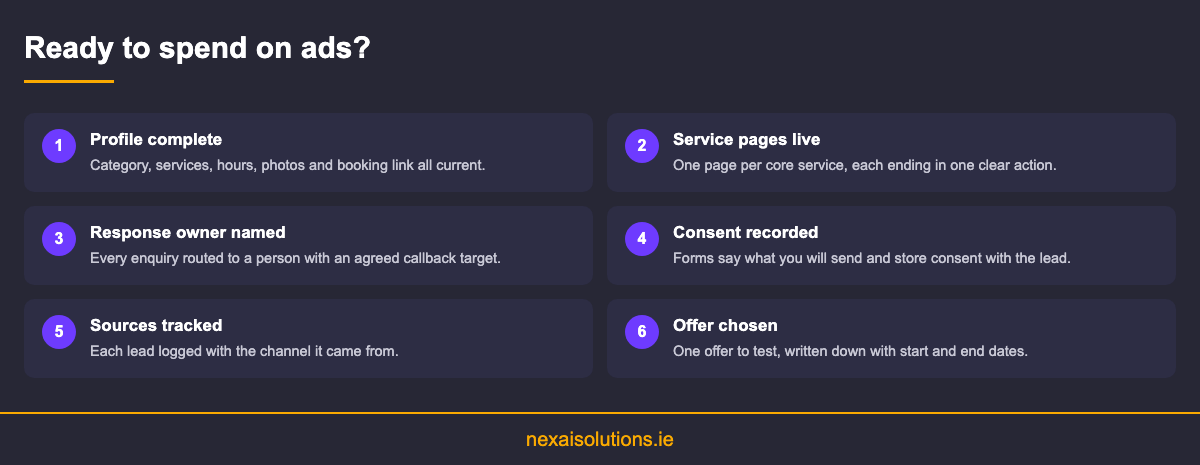
If you have more ideas than time, score each strategy on three things: how close it sits to the enquiry, what it costs to run each month, and how long it takes to set up. Start with the highest scoring idea you can finish within a few weeks, then move to the next.
Review the whole mix every quarter. Drop what has not produced qualified enquiries, put more behind what has, and line up the next offer test. Small, steady improvements in the right order beat a burst of activity across every channel at once.
Conclusion
A digital marketing lead generation strategy for a small business is mostly about order and discipline. Match your pages and profile to real searches, answer every enquiry quickly, and give visitors a reason to stay in touch. Then add paid tactics one at a time and test them properly. None of this needs a large team, just a clear plan and one place to see your leads. To map out which strategies suit your business, request a free strategy call with NexAI Solutions in Tullamore.
Frequently Asked Questions
What is a digital marketing lead generation strategy?
It is a plan for which online tactics you will use to turn interest into named enquiries, in what order, and how you will measure them. A good one fits your budget, your buyers and the time your team can realistically give it.
Which strategy should a small business start with?
Start with the tactics closest to the enquiry: a complete Google Business Profile and service pages that match real searches. They work for people already looking. More practical guides for small businesses are on the NexAI Solutions blog.
Is a lead magnet worth the effort for a local business?
It can be, if it solves a real question buyers have before they call. A cost guide, checklist or planning template often works better than a newsletter signup. Keep it short, specific to your service and honest about what you will send.
How quickly should I respond to a new enquiry?
As quickly as you reasonably can during working hours. Send an instant acknowledgement, then have a named person call or reply the same day. Enquiries cool fast, and a slow reply can hand the job to a competitor who answered first.
Does retargeting comply with GDPR in Ireland?
It can, provided visitors consent before tracking cookies are set. The ePrivacy rules and GDPR both apply. Use a clear cookie banner, an honest privacy notice and only build retargeting audiences from people who accepted tracking.
Are LinkedIn Lead Gen Forms only for large companies?
No. Small B2B firms can use them with modest budgets by targeting a narrow audience, such as one job role in one sector. The forms prefill profile details, so they suit offers like guides or short assessments aimed at business buyers.
How long should an offer test run?
Long enough to collect a fair number of enquiries, which depends on your traffic and season. Avoid judging a test on a single week. Change one thing at a time and write down the dates, the change and the result.
Should I hire someone to run these strategies?
If time is your main constraint, outside help can speed things up, provided you keep ownership of your data and see clear reporting. Our agency buyer checklist sets out what to check before signing.
Frequently Asked Questions
What is a digital marketing lead generation strategy?

Which strategy should a small business start with?
Is a lead magnet worth the effort for a local business?
How quickly should I respond to a new enquiry?
Does retargeting comply with GDPR in Ireland?
Are LinkedIn Lead Gen Forms only for large companies?
How long should an offer test run?
Should I hire someone to run these strategies?