Lead Generation Process Meaning: Definitions and Steps Explained
Lead Generation Process Meaning: Definitions and Steps Explained
 General
If you have searched for the lead generation process meaning, you probably want a plain answer rather than a funnel diagram full of acronyms. Put simply, it is the sequence of steps that turns a stranger into a sales conversation. This guide defines the terms you will hear, such as lead, MQL, SQL and conversion, then walks through each step in order. It also shows where the process usually breaks inside small teams, and what changes when it runs online. For the wider channel picture, start with our complete guide to winning leads online.
Key Takeaways
- The lead generation process moves people through five steps: attract, capture, qualify, nurture and hand off, with measurement running across all of them.
- An MQL has shown interest that marketing can work with, while an SQL is ready for a sales conversation.
- Small teams rarely fail at attracting interest. They lose leads to slow follow up, no qualification and scattered records.
Lead generation process meaning: what do lead, MQL and SQL stand for?
A lead is any person or organisation that has shown interest in what you sell and left a way to contact them. That could be a quote request, a downloaded guide, a booked call or a message on social media. Interest without contact details is just traffic.
Not every lead is equally ready. A marketing qualified lead, or MQL, has shown enough interest for marketing to keep the conversation going. They might have downloaded a price guide or signed up for advice emails, but they have not asked to buy.
A sales qualified lead, or SQL, is ready for a direct conversation. They match your ideal customer, have a real need and have asked for a quote, a call or a demo. The move from MQL to SQL is the most important handover in the whole process.
A conversion is any step you have defined as progress. Early on, it may be a form submission. Later, it is a signed proposal or a first invoice. Writing these definitions down, even for a team of two, stops arguments about whether marketing is working. It also makes your reports comparable from one month to the next, and it gives any new staff member or outside partner the same vocabulary from day one.
What are the steps of the lead generation process?
Most models describe the same journey, whatever names they use. Here it is broken into five working steps, with measurement wrapped around them rather than tacked on at the end.
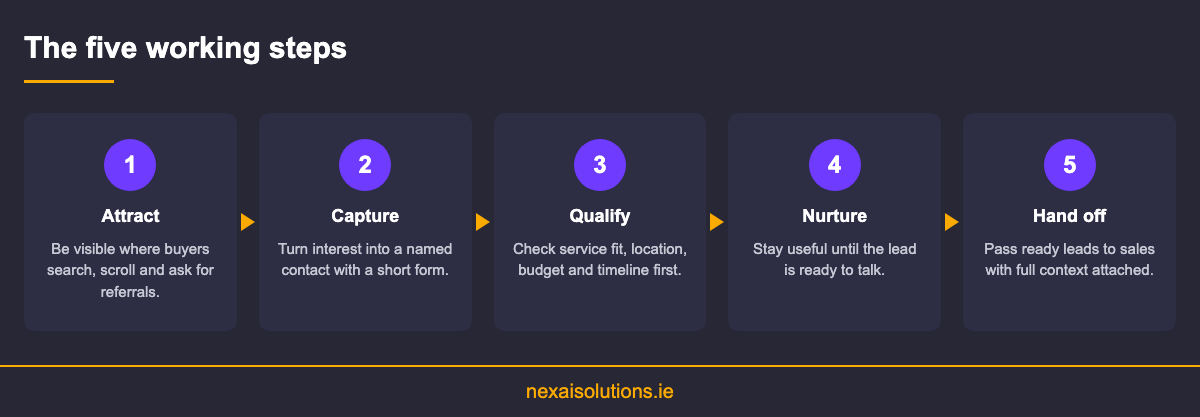
Attract is how people first find you. Search results, your Google Business Profile, social posts, referrals and ads all play a part. Google's SEO starter guide is a sound place to learn how search visibility is built.
Capture is the moment interest becomes a named contact. A short form, a click to call button, a booking link or a chat window does the job. Ask only for what you need to respond well, and be clear about how you will use the details. The Data Protection Commission publishes guidance on handling personal data lawfully.
Qualify means checking fit before you invest time. Does the person sit in your service area, need something you offer and have a realistic budget and timeline? A couple of well chosen form questions or a short discovery call can usually answer this. Qualifying early is not about turning people away rudely. It is about giving your best attention to the enquiries most likely to become good customers, and pointing the rest somewhere more useful.
What happens after a lead is qualified?
Nurture covers leads who fit but are not ready. Someone planning a renovation next spring, or a company waiting on budget approval, needs useful contact rather than pressure. Helpful emails, an answer to a question they raised or a check in call at the right moment keep you front of mind.
Hand off is where marketing passes a ready lead to whoever closes the sale. In a small business, that is often the owner. The handover should carry context: where the lead came from, what they asked, what they downloaded and any notes from earlier conversations. Nobody wants to explain their needs twice, and a lead who has to repeat themselves starts to doubt whether you were listening.
Measurement runs across every step. Count how many people you attract, how many become leads, how many qualify and how many buy, and record the source of each one. That data shows which step is leaking. A strong attract stage feeding a weak qualify stage needs a different fix from the reverse. Review the numbers monthly rather than daily. Small samples swing about, and a single quiet week tells you very little about whether a step is genuinely broken or simply having a slow patch.
If you bring in outside help, reporting should follow the same stages. Our piece on what to expect in the first 90 days of a retainer shows what a sensible start looks like.
Where does the lead generation process break for small teams?
Small businesses rarely struggle to attract some interest. A busy owner can usually point to calls, forms and messages coming in. The leaks tend to appear later, in three familiar places.
Slow follow up is the first. Enquiries arrive while the owner is on site, in a meeting or serving customers, and replies slip to the next day or the next week. By then the person has often gone elsewhere. An automatic acknowledgement and a fixed daily slot for callbacks solve much of this.
No qualification is the second. When every enquiry is treated the same, time goes to people who were never going to buy, and good leads wait in the queue. Two or three screening questions on the form, plus a simple rating of hot, warm or cold, focus the effort where it counts. Agree the rating rules once, so everyone on the team scores enquiries the same way.
Lost spreadsheets are the third. Leads scattered across a shared inbox, a notebook, a phone's call log and a spreadsheet nobody updates cannot be measured or nurtured. One CRM, even a basic one, fixes this. The NexAI platform includes a mini CRM for lead tracking beside a unified dashboard, so every enquiry's source and status sit in one view.
What does lead generation mean in digital marketing?
In a digital marketing context, the steps stay the same, but the way they run changes in three important ways.
First, everything is trackable. A form submission can carry its source, the page visited and the ad clicked, so you can see which campaigns produce qualified leads rather than guessing. Second, much of the process can be automated. Confirmation messages, nurture emails and reminders to call back go out without anyone needing to remember them.
Third, the rules are stricter. Collecting and using personal data online brings GDPR and electronic marketing rules into every step, from the wording beside a form to who can open your CRM. Consent becomes part of the process design rather than an afterthought. Get it right at capture and every later step, from nurture emails to reporting, rests on a sound footing.
The practical upshot is that a small team can now run a process that once needed a sales department. AI assisted tools draft nurture content, flag leads that have gone quiet and pull reporting together across channels. They do not replace your judgement on which leads matter, but they remove much of the admin around it.
Conclusion
Once you strip away the jargon, the lead generation process meaning is straightforward: attract, capture, qualify, nurture, hand off and measure. The harder part is running it consistently while you also run the business. Pick the step where you lose the most leads today and fix that first, then move to the next one. If you would like help mapping your own process and choosing the right tools, talk to the NexAI Solutions team about a free consultation.
Frequently Asked Questions
What is the lead generation process meaning in simple terms?
It is the series of steps a business uses to turn strangers into sales conversations: attracting attention, capturing contact details, qualifying fit, nurturing interest and handing ready leads to sales, while measuring results at each stage along the way.
What is the difference between an MQL and an SQL?
An MQL, or marketing qualified lead, has shown interest but is not ready to buy. An SQL, or sales qualified lead, fits your ideal customer and has asked for a quote, call or demo, so sales should act now.
How many steps are in the lead generation process?
Most models use five or six. This guide uses attract, capture, qualify, nurture and hand off, with measurement running across all five. The labels vary between businesses, but the journey from stranger to customer is broadly the same.
What does conversion mean in lead generation?
A conversion is any action you have defined as progress. It might be a form submission, a booked call or a signed proposal. Defining conversions clearly lets you compare channels and spot exactly where leads drop out.
Why do small businesses lose leads?
The usual causes are slow follow up, no qualification and scattered records. Leads go cold while waiting for a reply, time is spent on poor fits, and enquiries kept in inboxes or notebooks are never nurtured or measured.
Do I need a CRM for a small team?
If you handle more than a few enquiries a week, yes. A simple CRM records each lead's source, status and notes in one place, which makes follow up reliable and reporting possible without rebuilding spreadsheets every month.
How long does the lead generation process take?
It depends on what you sell. A household repair may move from search to booking in a day, while business software can take months of nurturing. Map your typical timeline so your follow up matches how your customers decide.
Should I outsource part of the process?
Many owners keep qualifying and closing in house and outsource attracting and capturing. Our guide to hiring a marketing partner outside Dublin covers what to look for, and you will find more guides on the NexAI blog.
Frequently Asked Questions
What is the lead generation process meaning in simple terms?

What is the difference between an MQL and an SQL?
How many steps are in the lead generation process?
What does conversion mean in lead generation?
Why do small businesses lose leads?
Do I need a CRM for a small team?
How long does the lead generation process take?
Should I outsource part of the process?