AI Digital Marketing: The Complete 2027 Guide for Irish SMEs
AI Digital Marketing: The Complete 2027 Guide for Irish SMEs
 General
AI digital marketing is no longer something only large brands try. In 2025, 20.2% of enterprises in Ireland used AI technologies in some form, according to the Central Statistics Office's Information Society Statistics for enterprises, and the share among small firms is climbing. For an Irish SME owner, the real question is no longer whether to use AI, but where it saves time, where it needs a human hand, and how to stay on the right side of GDPR and the EU AI Act while doing it.
This guide explains AI in digital marketing in plain English, then walks through each part of the marketing job, from strategy and SEO to ads, social, content, follow-up and reporting. It finishes with the rules you need to know and a simple way to get started in 2027.
Key Takeaways
- AI digital marketing means using software that learns from data to draft, test, schedule and report on marketing work, while people set goals, check output and own customer relationships.
- Irish adoption is growing fast but unevenly: the CSO found 17.2% of small enterprises used AI in 2025, against 57.7% of large ones, so most SMEs are still early.
- The safest path is to start with two repetitive jobs, such as reporting and lead follow-up, keep a human review step, and check GDPR and EU AI Act duties before you scale.
What Is AI Digital Marketing, in Plain English?
AI digital marketing is the use of software that can learn from data, spot patterns and produce output, such as text, images, bids or reports, to do parts of your marketing work. Traditional marketing software follows fixed rules you set. AI tools adapt: they look at what has worked and suggest, or make, the next change.
In practice, that means things like a tool that drafts ten versions of an ad headline, a system that moves budget towards the search terms bringing enquiries, or a dashboard that pulls results from your website, Google Business Profile and social channels into one weekly summary. None of these replace the need to know your customers. They remove a lot of the copying, checking and guessing that eats into a small team's week.
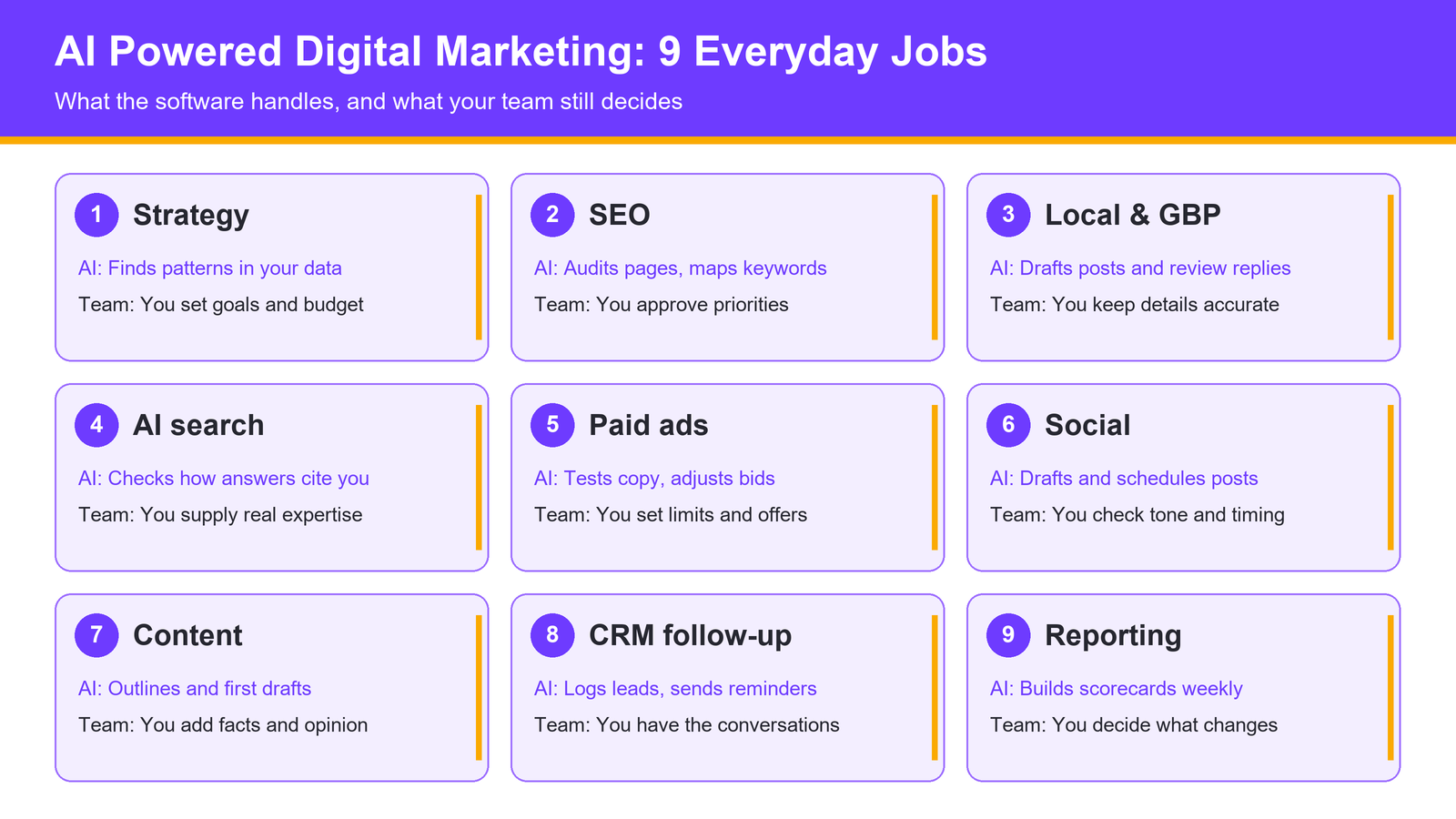
It helps to think of AI powered digital marketing as three layers. The first is assistance: drafting, summarising and suggesting. The second is automation: scheduling, routing leads and adjusting bids within limits you set. The third is analysis: finding patterns across channels that a person would take days to see. Most Irish SMEs get value from the first two layers long before they need the third.
What AI digital marketing is not is a "set and forget" machine. Every serious tool still needs clear goals, clean data and someone to review what it produces. The firms that get the most out of it treat AI as a capable junior colleague, not as the person in charge.
Where Do Irish SMEs Stand on AI Adoption?
Ireland has moved quickly. A CSO feature article on what CSO data tells us about AI use in Ireland shows enterprise AI use rising from about 8% in 2023 to 15% in 2024 and more than 20% in 2025. That puts Ireland level with the EU average of 20%, though well behind leaders such as Denmark at 42%.
Size makes a big difference. The CSO's 2025 figures show 57.7% of large enterprises used AI, compared with 28.6% of medium and 17.2% of small enterprises. In other words, most small Irish firms are still at the starting line, which is both a risk and an opportunity. Competitors who adopt sensible AI workflows now will be faster at responding to enquiries and cheaper per lead within a year or two.
Marketing is one of the main places AI shows up. The CSO reports that marketing or sales was among the most common business uses in Ireland, at 5.4% of enterprises, level with ICT services and R&D. Across Europe, Eurostat's statistics on AI use in enterprises found that 34.70% of EU enterprises using AI used it for marketing or sales in 2025, ahead of business administration at 31.05%.
The barriers are familiar to any small business owner. Among EU enterprises that had considered AI but not used it, Eurostat found the most common reason was a lack of relevant expertise (70.89%), followed by a lack of clarity about legal consequences (52.52%) and concerns about data protection and privacy (48.83%). Those three issues, skills, rules and data, are exactly what the rest of this guide tries to make simpler.
How Does AI Help With Marketing Strategy and Planning?
Strategy is where many owners assume AI has least to offer, but it is often where the first useful insight comes from. AI tools can review your past website traffic, enquiry sources, ad spend and seasonal patterns, then point out what actually produced customers. That is a better starting point than a plan built on habit.
A practical workflow looks like this. You connect your analytics, ad accounts and lead records. The software summarises which channels brought enquiries, which brought only clicks, and when demand peaks. It then suggests a draft plan: where to spend, what to publish and which keywords to target. You and your team review that plan against what you know about margins, capacity and the local market, and adjust it.
AI is also good at keeping a plan alive. Instead of a strategy document that sits in a folder until next year, the plan becomes a set of targets that the system checks weekly. If one channel drops or costs rise, you see it early. Pairing this with a clear view of how demand creation differs from capturing existing interest helps you decide whether the fix is more awareness or better conversion.
What AI cannot do is decide what your business stands for, which customers you want more of, or how much risk you can afford. Those choices still sit with the owner. The software only sharpens the evidence behind them.
How Does AI Change SEO, Local Search and AI Search?
Search is the channel where AI has changed the most, both in how you do the work and in how customers find answers. On the work side, AI tools can crawl your site for technical issues, group keywords by intent, suggest internal links and draft page outlines. Jobs that used to take an agency a week can be done as a first pass in hours, leaving people to judge which fixes matter.
For local businesses, Google Business Profile is often worth more than the website. AI can draft regular posts, suggest replies to reviews and flag when your opening hours, categories or photos are out of date. A Tullamore café or a Galway accountant gains far more from a complete, active profile than from a dozen generic blog posts. The human job is to make sure every detail is accurate and every review reply sounds like you.
Then there is AI search itself. Google now shows AI Overviews and AI Mode answers, and many customers also ask assistants like ChatGPT for recommendations. Google's own guidance on AI features and your website says there are no additional requirements or special optimisations needed to appear in AI Overviews or AI Mode. A page must be indexed and eligible for a snippet in normal Search, and the usual SEO basics apply: crawlable pages, internal links, important content available as text, structured data that matches the page, and up-to-date Business Profile information.
That is good news for SMEs. The work that helps you in AI search is the same work that helps in classic search: clear answers to real customer questions, honest expertise, accurate business details and pages that load quickly. AI tools can check how often your brand appears in AI answers and which questions you are missing, but the content that earns those mentions still has to come from people who know the trade.
How Is AI Used in Paid Ads and Social Media?
Paid advertising was one of the first areas where AI became standard. Google Ads and Meta's ad platforms already use machine learning to set bids, choose placements and decide which version of an ad to show. For an SME, the question is less "should I use AI in ads?" and more "how do I give the platform's AI good inputs and sensible limits?"
A sound workflow has four parts. First, you track the right conversion, such as a form submission or a phone call, not just clicks. Second, you set a daily budget and a target cost per enquiry you can live with. Third, you use AI tools to write and test several headlines and descriptions, then keep the winners. Fourth, a person reviews search terms and placements weekly, adding negatives and pausing anything off-brand. Our guide to building a lead plan around your marketing budget covers how to set those targets.
Social media follows a similar pattern. AI can draft posts from your blog content, suggest captions for photos, resize images for each platform and schedule everything for the times your audience is active. Social insights tools can summarise which posts drew comments, clicks or enquiries, so you stop guessing what works.
The risk on social is sameness. Many AI-written posts read alike, and Irish audiences notice. Keep the AI on drafting and scheduling, and keep people on the photos, local references, humour and replies that make a page feel run by real people.
How Can AI Support Content, CRM Follow-Up and Reporting?
Content is where most owners first try AI, usually by asking a chatbot to write a blog. Used well, AI speeds up research, outlines, first drafts and repurposing, such as turning one article into social posts and an email. Used badly, it produces bland pages with no real expertise, which neither customers nor search engines reward. The rule of thumb: AI drafts, a person adds the facts, examples, prices, opinions and local knowledge that only your business has.
Follow-up is where AI often pays for itself fastest. Many SMEs lose enquiries not because the marketing failed but because nobody replied for two days. A simple AI-assisted CRM can log every enquiry from your website, ads and Google Business Profile in one place, remind the right person to call, and send a polite acknowledgement straight away. If you still track leads in spreadsheets, our piece on moving lead tracking into a GDPR-ready CRM explains why that matters for both sales and compliance.
Reporting is the third quick win. Instead of logging into five dashboards every Monday, AI tools can pull data from your website, ads, social channels and Business Profile into one scorecard. Better still, they can explain the numbers in plain sentences: which channel brought most enquiries, what each one cost and what changed since last month.
Together, these three jobs are what most AI marketing solutions Ireland's small firms buy actually do day to day. They are not glamorous, but they free up hours every week and stop leads slipping through the cracks.
What Should Stay Human in AI Marketing?
Some decisions should never be handed to software, however good it gets. Your positioning, your pricing, the promises you make in ads and the way you treat customers are business decisions with legal and reputational weight. AI can model options, but a person must choose.
Customer conversations are the second area to protect. AI can acknowledge an enquiry and book a call, but the sales conversation, the complaint handling and the review reply to an unhappy customer deserve a human. People in Ireland still buy from people, especially in trades, professional services and hospitality where trust carries the sale.
Third, quality control. The Data Protection Commission's guidance on AI, large language models and data protection warns that AI outputs can be inaccurate or biased and that purely automated decisions have the potential to cause harm. In marketing terms, that means a person should review every customer-facing output before it goes live, from ad copy to automated emails.
Finally, judgement about what is worth doing at all. AI makes it cheap to produce more content, more ads and more posts. It does not tell you whether more is what your business needs. Often the better move is fewer, sharper campaigns aimed at the customers you most want.
What Do GDPR and the EU AI Act Mean for Your Marketing?
GDPR applies to AI marketing exactly as it applies to any other marketing. If a tool processes personal data, such as names, emails, phone numbers or browsing behaviour, you still need a lawful basis, clear privacy information, sensible retention periods and a way to handle access and deletion requests. Electronic marketing to individuals also needs to meet Irish e-privacy rules on consent. None of that changes because software is doing the work.
The DPC's guidance gives a useful checklist for any business using AI tools. Find out what personal data the system uses and where it goes, especially when a third-party provider is involved. Check whether the provider keeps or reuses your data. Consider a formal risk assessment before you start. Set a retention schedule, and require critical human review of outputs that inform decisions about individuals. A practical step many firms miss is a staff rule on what may and may not be pasted into public AI chatbots.
The EU AI Act adds a second layer. According to the European Commission's AI Act overview, prohibited practices and AI literacy obligations have applied since 2 February 2025, and the Act's transparency rules came into effect in August 2026. For marketers, the key transparency points are that people should be made aware when they are interacting with a machine, such as a website chatbot, and that deepfakes and certain AI-generated content must be clearly labelled.
Most everyday marketing uses fall into the Act's lower-risk categories, and rules for high-risk uses listed in Annex III, such as recruitment software and credit scoring, now apply from 2 December 2027. That does not mean "no rules". It means your main duties are to train staff who use AI, be open with customers when they are talking to a bot, label synthetic images or video honestly, and keep GDPR at the centre of your data handling.
Agency, Platform or Hybrid: Which Model Fits Your Business?
Once you decide to use AI, the next choice is who runs it. There are three broad models, and each suits a different kind of SME. We will cover this decision in more depth in a dedicated post, but the short version is below.
An agency runs the work for you. You get experienced people and less to learn, but you may have less day-to-day visibility, and costs rise with the hours involved. A self-serve platform puts AI tools in your hands. It is usually cheaper per month and gives you full control, but someone on your team needs the time and skills to use it well, which Eurostat's figures on missing expertise suggest is often the sticking point. Before hiring anyone, it helps to understand what Irish marketing services usually include and how to vet an Irish marketing partner.
A hybrid model combines both: AI digital marketing software does the repetitive work, and a team of specialists sets strategy, reviews output and handles the parts that need judgement. For many SMEs this is the most realistic option, because it pairs the speed and lower cost of software with the expertise most small teams lack. When you compare options, ask who reviews AI output, where your data is stored, how you can export it, and what reports you will see each month.
NexAI Solutions is one example of the hybrid approach. Its platform uses AI agents to create, run and optimise a marketing strategy tailored to each business, with a Mini CRM for leads and interactions, one unified dashboard for digital assets, scheduled publishing to social channels and the website, automatic website and Google Business Profile optimisation, performance reports and scorecards, and expense management with ROI analysis. Alongside the platform, its team provides managed services across performance marketing, SEO, Google Business Profile optimisation, social media, AI search optimisation, content creation and marketing automation with CRM integration. Whichever model you lean towards, test it against your own goals rather than any vendor's promises.
How Do You Get Started With AI Digital Marketing?
The best first step is not buying software. It is deciding what you want more of. Pick one measurable goal, such as qualified enquiries per month or booked appointments, and note where you are today. Without a baseline, you will never know whether AI is helping.
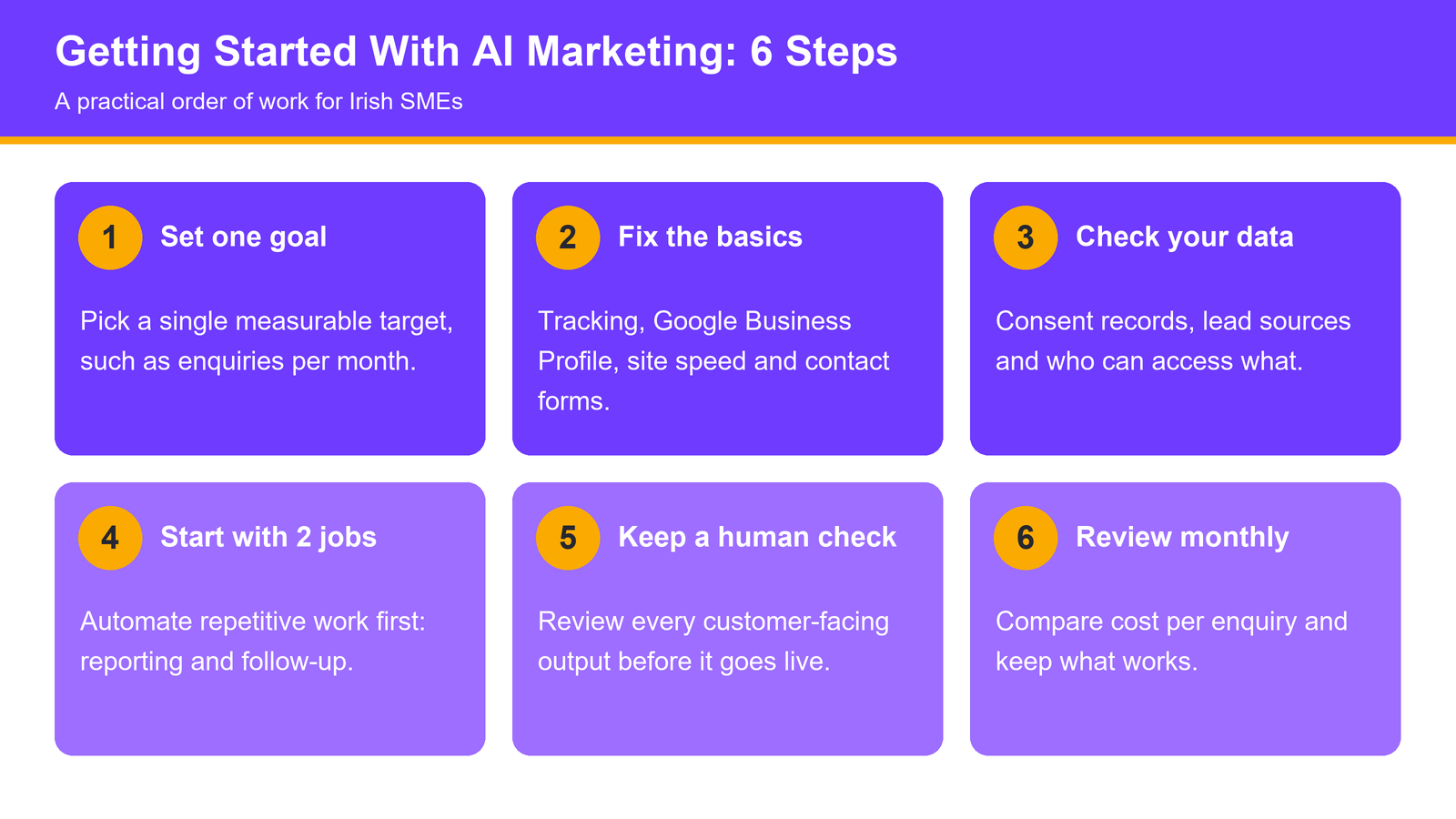
Next, fix the basics. Make sure conversion tracking works, your Google Business Profile is complete, your site loads quickly and your contact forms reach a real inbox. Then check your data: where leads are stored, what consent you hold and who can access what. Our round-up of software for capturing and tracking leads can help you see where gaps are.
Then start small. Choose two repetitive jobs, such as weekly reporting and lead follow-up, and automate those first. Keep a human check on everything customer-facing. After a month, compare your cost per enquiry and response times with your baseline, keep what worked and drop what did not. Only then add a third job, such as social scheduling or ad copy testing.
Funding can help. The Department of Enterprise's page on digital transformation supports for SMEs lists the Local Enterprise Office Digital for Business programme, described as a free digital and AI readiness audit, and the Grow Digital Voucher, which offers up to €5,000 at 50% funding and supports AI tools, software and implementation. Enterprise Ireland's Digital Discovery Grant covers up to 80% of costs, to a maximum of €5,000, for businesses exploring digital and AI opportunities. Check eligibility with your Local Enterprise Office or Enterprise Ireland before you commit.
Conclusion
AI digital marketing is now a practical option for Irish SMEs, not a future trend. The CSO's figures show adoption more than doubling in two years, yet most small firms are only starting. That leaves room for businesses that move carefully: set one goal, fix the basics, automate repetitive work, keep people in charge of judgement and customer relationships, and follow GDPR and the EU AI Act from day one.
You do not need to choose between doing everything yourself and handing everything over. Software can carry the repetitive load while experienced people steer the strategy. If you would like to map out where AI could save your team time and win more enquiries, talk to the NexAI Solutions team for a free consultation.
Frequently Asked Questions
What is AI digital marketing?
AI digital marketing is the use of software that learns from data to help plan, create, run and measure marketing. Typical uses include drafting ad copy and posts, adjusting ad bids, grouping keywords, following up leads and building reports. People still set the goals, review the output and handle customer conversations.
Is AI digital marketing suitable for small businesses in Ireland?
Yes, as long as you start with clear goals and small, repetitive tasks. CSO figures show 17.2% of small Irish enterprises used AI in 2025, so many small firms are already testing it. Reporting, lead follow-up and social scheduling are usually the easiest places to begin.
How is AI used in digital marketing day to day?
Common daily uses include writing first drafts of content, scheduling social posts, suggesting Google Business Profile posts and review replies, testing ad headlines, logging enquiries in a CRM and summarising performance in one dashboard. Each of these saves time while a person checks quality before anything goes live.
Does AI marketing replace a marketing agency or in-house team?
Not fully. AI handles volume and speed, but strategy, brand voice, customer relationships and compliance still need people. Many SMEs find a hybrid model works best, where software does the repetitive work and specialists guide it and review the results.
Is AI marketing GDPR compliant?
It can be, but compliance depends on how you use it. You still need a lawful basis for processing personal data, clear privacy information, consent for electronic marketing where required and a way to handle access and deletion requests. The Data Protection Commission recommends checking what data a tool uses, where it goes and whether the provider reuses it.
What does the EU AI Act mean for marketers?
For most marketing uses, the main duties are AI literacy for staff, telling people when they are talking to a chatbot, and clearly labelling deepfakes and certain AI-generated content. The Act's transparency rules came into effect in August 2026. High-risk rules mostly apply to areas such as recruitment and credit scoring rather than everyday marketing.
How do I appear in Google's AI Overviews?
Google says there are no special requirements for AI Overviews or AI Mode beyond being indexed and eligible for a snippet in normal Search. Focus on clear answers to real customer questions, crawlable pages, good internal linking, accurate structured data and an up-to-date Business Profile.
Are there grants for AI marketing tools in Ireland?
Yes. The Local Enterprise Office Grow Digital Voucher offers up to €5,000 at 50% funding and supports AI tools, software and implementation, and the Digital for Business programme offers a free digital and AI readiness audit. Enterprise Ireland's Digital Discovery Grant covers up to 80% of costs to a maximum of €5,000. Check current eligibility with your Local Enterprise Office or Enterprise Ireland.