GDPR-Ready AI CRM in 2027: Why Irish Marketing Teams Are Ditching Spreadsheet Lead Tracking
GDPR-Ready AI CRM in 2027: Why Irish Marketing Teams Are Ditching Spreadsheet Lead Tracking
 General
More than one in five businesses in Ireland now use artificial intelligence, according to the Central Statistics Office's 2025 enterprise survey. Yet many marketing teams still track every lead in a shared spreadsheet. That gap is closing fast, and GDPR is a big reason why. Choosing AI CRM software Ireland teams can trust means picking a system that records consent, controls access and keeps a clean audit trail. If you want to see how that could work for your team, talk to the NexAI Solutions team for a free consultation. This guide explains why spreadsheets are falling out of favour, what GDPR expects from lead data, and how to plan a calm switch before 2027.
Key Takeaways
- Spreadsheet lead tracking creates duplicate records, weak access control and no audit trail, which makes GDPR requests and breach reporting harder.
- A GDPR-ready AI CRM stores consent, source and retention dates with every lead, then uses automation and lead scoring to save sales time.
- Teams shortlisting the best AI CRM for Irish SMEs 2027 should test data hosting, permissions, exports and deletion workflows before features.
Why Spreadsheet Lead Tracking Breaks Down
Spreadsheets feel free and flexible. In practice they split one customer into many versions, hide who changed what, and push staff into manual data entry. As lead volumes grow, the hidden cost shows up as lost deals, wasted hours and weaker trust in the numbers.
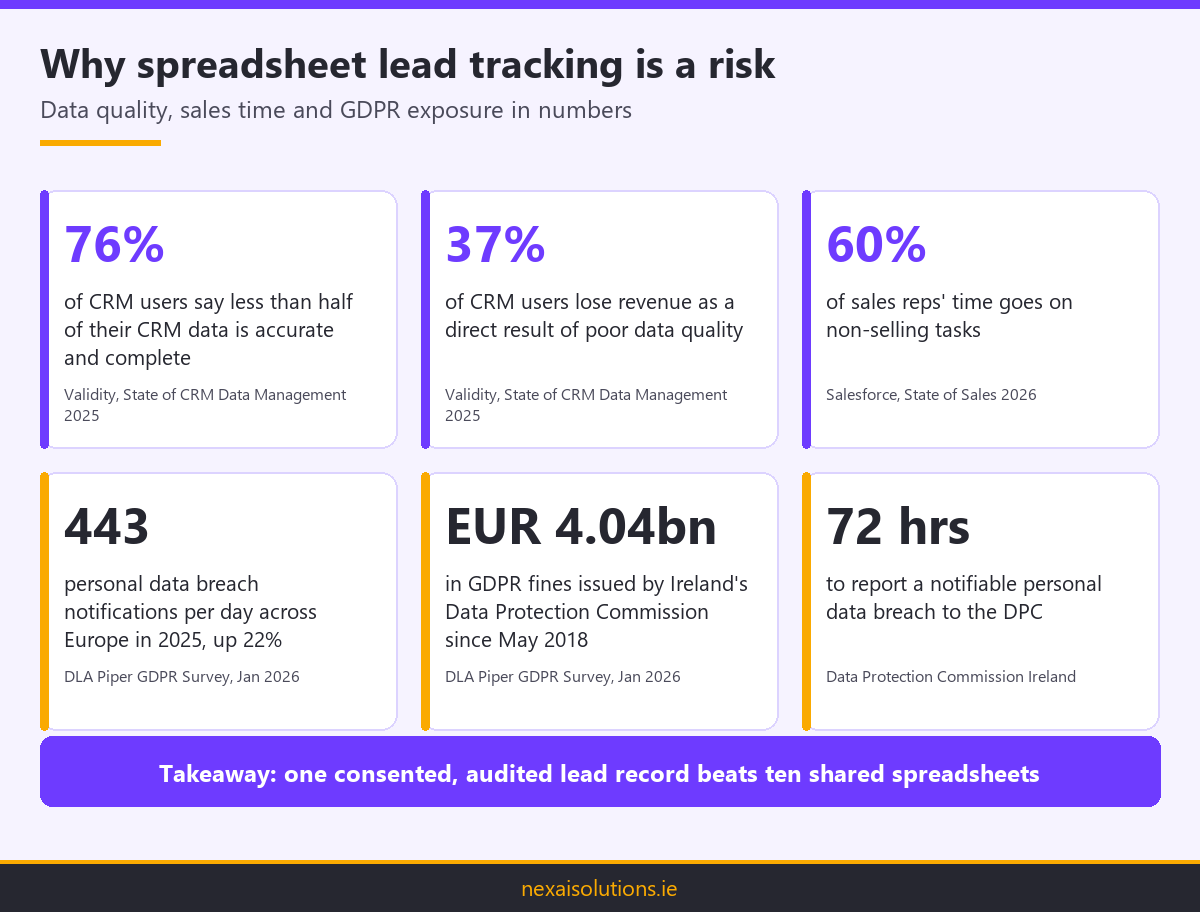
Data quality is the first casualty. In the Validity State of CRM Data Management 2025 survey, 76% of 602 CRM users said less than half of their CRM data is accurate and complete. 37% said their firm loses revenue as a direct result of poor data quality. Spreadsheets make this worse because nothing stops a typo, a duplicate row or an outdated phone number.
Time is the second casualty. The Salesforce State of Sales report found that reps spend 60% of their time on non-selling tasks. Copying form fills into a sheet, chasing colleagues for updates and rebuilding reports all eat into that time.
For marketing agencies in Dublin, Cork or Galway, the pain multiplies. Each client brings its own campaigns, forms and contacts. One shared file per client quickly becomes ten files, each with a slightly different version of the truth.
What GDPR Expects From Your Lead Data
GDPR does not ban spreadsheets. It asks you to know what personal data you hold, why you hold it, who can see it and how fast you can act on it. Those duties are hard to meet when leads live in exported files, inboxes and personal drives.
Ireland sits at the centre of European enforcement. The DLA Piper GDPR Fines and Data Breach Survey reports that Ireland's Data Protection Commission has issued EUR 4.04 billion in fines since May 2018. Across Europe, regulators received an average of 443 breach notifications per day in 2025, up 22% on the previous year.
Most of those headline fines involve large platforms, but the rules apply to every business. The Data Protection Commission's breach notification guidance says organisations must report a notifiable breach within 72 hours of becoming aware of it. If a laptop holding a lead spreadsheet goes missing, could your team say exactly which contacts were on it within that window?
The same problem appears with access and deletion requests. When a contact asks what you hold about them, you need one place to search, not a hunt through old attachments. A central CRM with permissions and history turns these requests into routine admin instead of a scramble.
What Makes an AI CRM GDPR Ready
A GDPR-ready CRM is not just a database with a privacy badge. It builds data protection into daily work, so consent, access and retention are handled every time a lead arrives. AI then helps teams act faster on that clean data rather than guessing.
Use this checklist when you compare platforms:
- Lawful basis and consent fields. Every lead record should show where it came from, when consent was given and for what purpose.
- Role based access. Sales, marketing and client teams should only see the records they need.
- Audit trail. The system should log who viewed, edited, exported or deleted a record.
- Retention rules. Old, inactive leads should be flagged for review or removal on a schedule.
- Easy export and deletion. You should be able to answer an access or erasure request from one screen.
- Clear data hosting terms. Ask where data is stored and which processors are involved.
Agencies that manage many clients often add AI lead scoring software for Dublin marketing agencies on top of this foundation. Scoring ranks leads by fit and engagement, so account managers call the warmest prospects first. It only works well when the underlying data is accurate, which is why the GDPR basics come first. In the same Salesforce research, 84% of data and analytics leaders agreed that AI outputs are only as good as the data that goes in. That is why a well run AI CRM software Ireland rollout starts with clean records.
Where Irish Businesses Stand on AI Adoption
Irish firms are adopting AI at roughly the European pace, but smaller businesses lag behind larger ones. That gap creates an opening for SMEs that modernise their lead handling now, before competitors do.
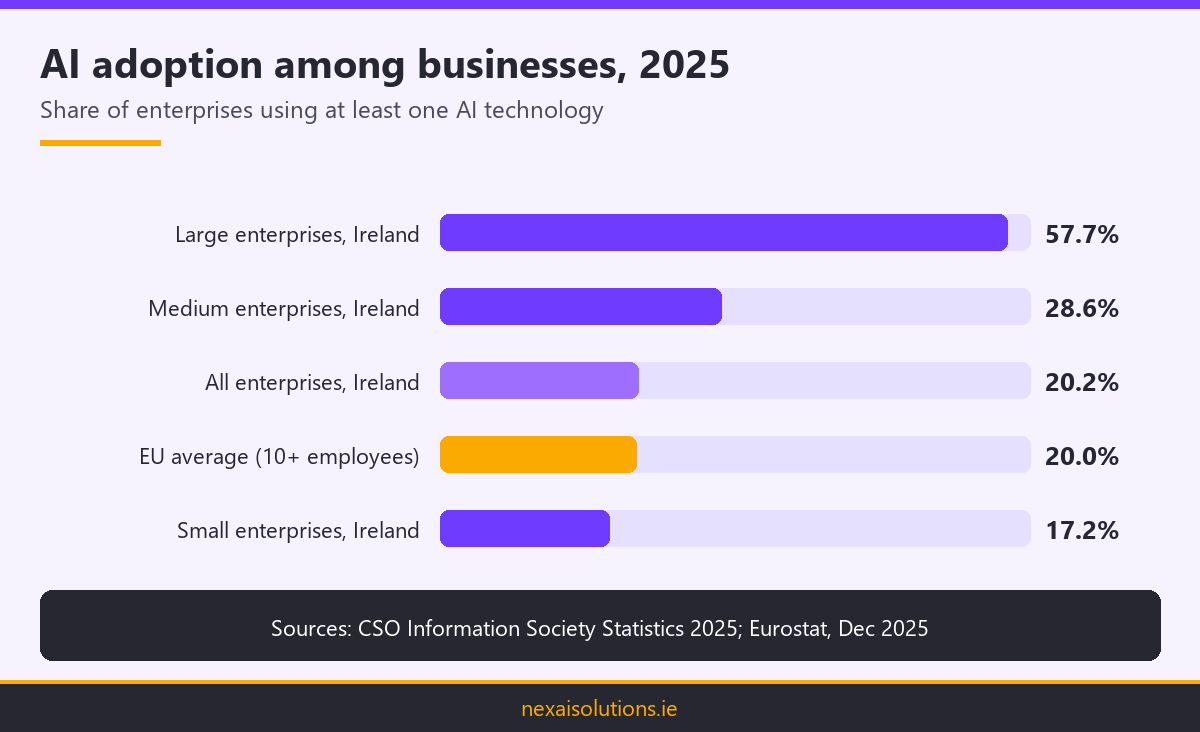
CSO figures show that 20.2% of Irish enterprises used AI in 2025, up from just over 15% in 2024. Large enterprises led at 57.7%, while only 17.2% of small enterprises used it. Marketing or sales was one of the main uses, at 5.4% of enterprises. Across the bloc, Eurostat reports that 20% of EU enterprises with ten or more employees used AI in 2025, up from 13.5% a year earlier.
Looking ahead to 2027, the outlook is for AI to become a normal part of sales and marketing tools rather than an add on. For a small team, that means the choice of AI CRM software Ireland businesses make in the next year will shape how easily they can use automation later. A CRM with clean, consented data is ready for scoring, automated follow ups and reporting. A spreadsheet is not.
How to Move From Spreadsheets to an AI CRM
A switch does not need a big IT project. Most SMEs and agencies can move in stages over a few weeks, cleaning data as they go so the new system starts with records they can trust and defend.
- Audit your sheets. List every file, inbox and form that holds lead data, and note who owns each one.
- Clean and deduplicate. Merge duplicates, remove contacts with no clear lawful basis and fix missing source details.
- Map your fields. Decide which fields you need, including consent date, source, owner and next action.
- Set permissions and retention. Agree who sees what and how long inactive leads are kept.
- Connect your channels. Route website forms, ads and social enquiries straight into the CRM, not into a sheet.
- Retire the spreadsheets. Archive or securely delete old files once the import is checked.
The NexAI Solutions platform includes a mini CRM for lead and interaction tracking, alongside AI powered marketing tools for campaigns, SEO and reporting. Keeping leads and campaign data in one place makes it easier to see which channels drive real enquiries. Our guide to digital lead generation explains how those channels feed your pipeline, and our overview of digital marketing services in Ireland shows what a full programme can include.
Conclusion
Spreadsheets got many Irish teams started, but they struggle with accuracy, speed and GDPR duties as lead volumes grow. A GDPR-ready approach to AI CRM software Ireland businesses can rely on puts consent, access control and audit trails first, then layers on AI scoring and automation. With Irish AI adoption rising and enforcement staying firm, now is a sensible time to plan the move before 2027 budgets are set. To explore how a single lead and marketing platform could work for your business, book a free consultation with NexAI Solutions or browse more guides on the NexAI blog.
Frequently Asked Questions
What is AI CRM software in Ireland?

Is it illegal to track leads in a spreadsheet under GDPR?
What makes a CRM GDPR ready?
How quickly must an Irish business report a data breach?
How does AI lead scoring help marketing agencies?
How many Irish businesses use AI?
What should Irish SMEs look for in the best AI CRM for 2027?
How long does it take to move from spreadsheets to a CRM?
Can a CRM help with data access requests?
Does NexAI Solutions offer a CRM?