AI Marketing Agency or AI Marketing Platform? How Irish SMEs Should Decide
AI Marketing Agency or AI Marketing Platform? How Irish SMEs Should Decide
 General
Choosing an AI digital marketing agency is now a different decision from the one Irish business owners faced even three years ago. The CSO's Information Society Statistics for 2025 found that 20% of Irish enterprises used AI in 2025, up from 15% in 2024, and that more than 17% of small enterprises now use it, so the question is no longer whether AI belongs in your marketing but who should run it.
This guide compares the three main models on the factors that matter to a small Irish business, then gives you a checklist to match one to your situation.
Key Takeaways
- The right model depends on your time, in-house skills and how much control you want, not on which option sounds most advanced.
- Data ownership and GDPR responsibilities change with each model, so ask who holds your data and whether a processing agreement is in place.
- Local Enterprise Office supports such as the Grow Digital Voucher can help with new software costs, but check eligibility with your LEO before you spend anything.
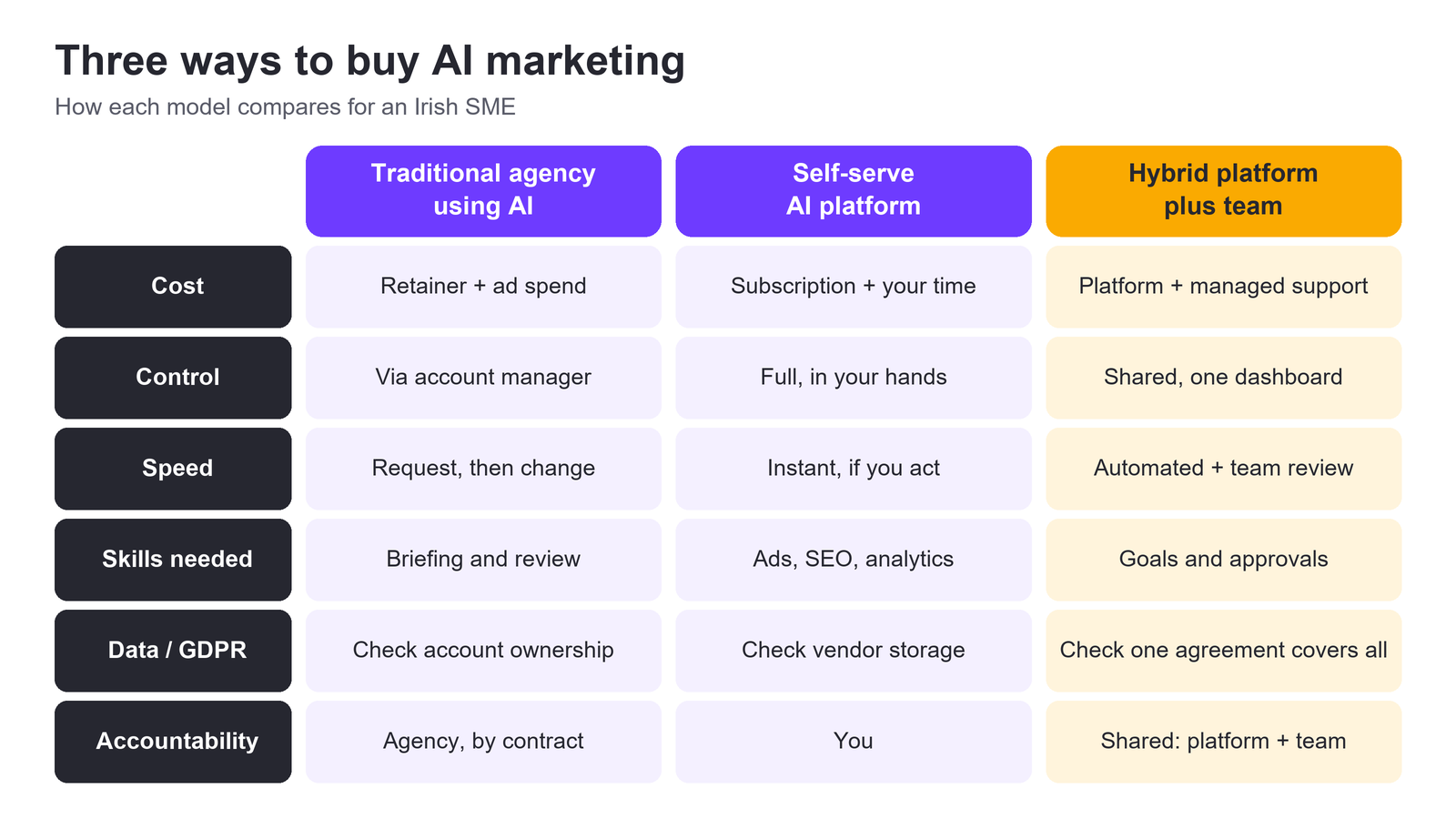
What are the three ways to buy AI marketing in Ireland?
The first model is the traditional agency using AI. You pay a monthly retainer, an account team runs your campaigns, and AI tools sit in the background to speed up copywriting, reporting or bid management.
The second is the self-serve AI platform. You subscribe to software that can draft content, schedule posts, adjust ads or audit your website, and you or a staff member operate it. Adoption of this kind of tooling is widespread: the HubSpot 2026 State of Marketing report says 80% of marketers use AI for content creation. The software is only as good as the person setting goals and checking its work, though.
The third is the hybrid platform plus team. Here AI agents create, run and optimise a marketing strategy inside one dashboard, and a managed team reviews the strategy, handles the parts that need judgement and answers your questions. This is the model NexAI Solutions uses, combining the platform with managed services such as SEO, performance marketing and Google Business Profile optimisation.
If you want the wider context on what AI actually does across channels, our practical guide to AI-led marketing for Irish SMEs covers the fundamentals before you choose a delivery model.
How do the costs compare between an agency, a platform and a hybrid?
A traditional agency usually charges a retainer that reflects the hours its people spend on your account, plus your ad budget. Costs scale with workload, so a new channel or second location generally means a bigger retainer, but you know what you pay each month.
A self-serve platform typically charges a subscription, which looks cheaper on paper. The hidden cost is your own time, or the salary of the person who operates it, which never appears on an invoice.
A hybrid model sits between the two. You pay for the platform and the managed support together, and the automation handles repetitive tasks such as scheduled publishing and reporting, so people spend their time on strategy rather than production. Whatever you compare, count the full cost of ownership: fees, ad spend, internal time and the cost of switching later.
Which model gives you more control and speed?
With a traditional agency, changes usually go through an account manager, which adds a step but also a second pair of eyes. Reports often arrive monthly, so a problem can run for weeks before anyone spots it.
A self-serve platform gives you full control and instant changes. The risk is that full control means full responsibility: if nobody checks the platform for a fortnight because the business got busy, nothing moves.
A hybrid model aims to give you visibility without the workload. One unified dashboard shows your digital assets, leads and performance scorecards, while the team acts on what the data shows. If you run seasonal offers, ask each provider how long a typical change takes from request to live.
What skills does your team need for each option?
With a traditional agency, you need someone who can write a clear brief, review work and judge whether the results are good. Our article on what to look for when hiring an Irish marketing agency covers the questions worth asking.
A self-serve platform demands the most: someone must understand ads, SEO, content and analytics well enough to direct the AI and catch its mistakes. Global adoption is rising fast, with the Stanford AI Index 2025 reporting that 78% of organisations used AI in 2024, up from 55% the year before, but using a tool is not the same as using it well.
The hybrid model needs the least specialist skill on your side. You set goals, approve key decisions and respond to leads in the CRM, while the platform and team handle execution.
Who owns your data, and what does GDPR require?
This is where the three models differ most. When any outside provider handles customer data for you, such as email lists, enquiry forms or CRM records, you are usually the data controller and they are a processor. The Data Protection Commission's guidance on controller-processor contracts states that GDPR obliges controllers and processors to enter into a legally binding contract governing that processing.
With a traditional agency, data often lives across tools the agency chooses, and some accounts may be registered in the agency's name. Insist that your ad accounts, analytics and CRM belong to your business.
With a self-serve platform, you hold the account, but check where the vendor stores data, whether it uses sub-processors outside the EEA and what happens to your data if you cancel. With a hybrid model, look for one place where leads and interactions are recorded, such as a Mini CRM, and confirm the processing agreement covers both the software and the managed team. Our guide to setting up a GDPR-ready CRM in Ireland goes into the practical steps.
Who is accountable when results fall short?
With an agency, accountability is contractual: you can point to the scope of work and ask why targets were missed. The catch is that some agencies report on activity, such as posts published, rather than outcomes like enquiries and sales.
With a self-serve platform, accountability rests with you. The software does what it is told, so if the strategy is wrong, the results will be too.
A hybrid model shares accountability: the platform tracks performance, expenses and ROI, and the team is responsible for acting on it. Whichever model you choose, agree in writing which metrics matter, how they are reported, and what happens if they are not met. If lead volume is your main goal, see how outsourcing lead generation to a specialist partner changes the way results are measured.
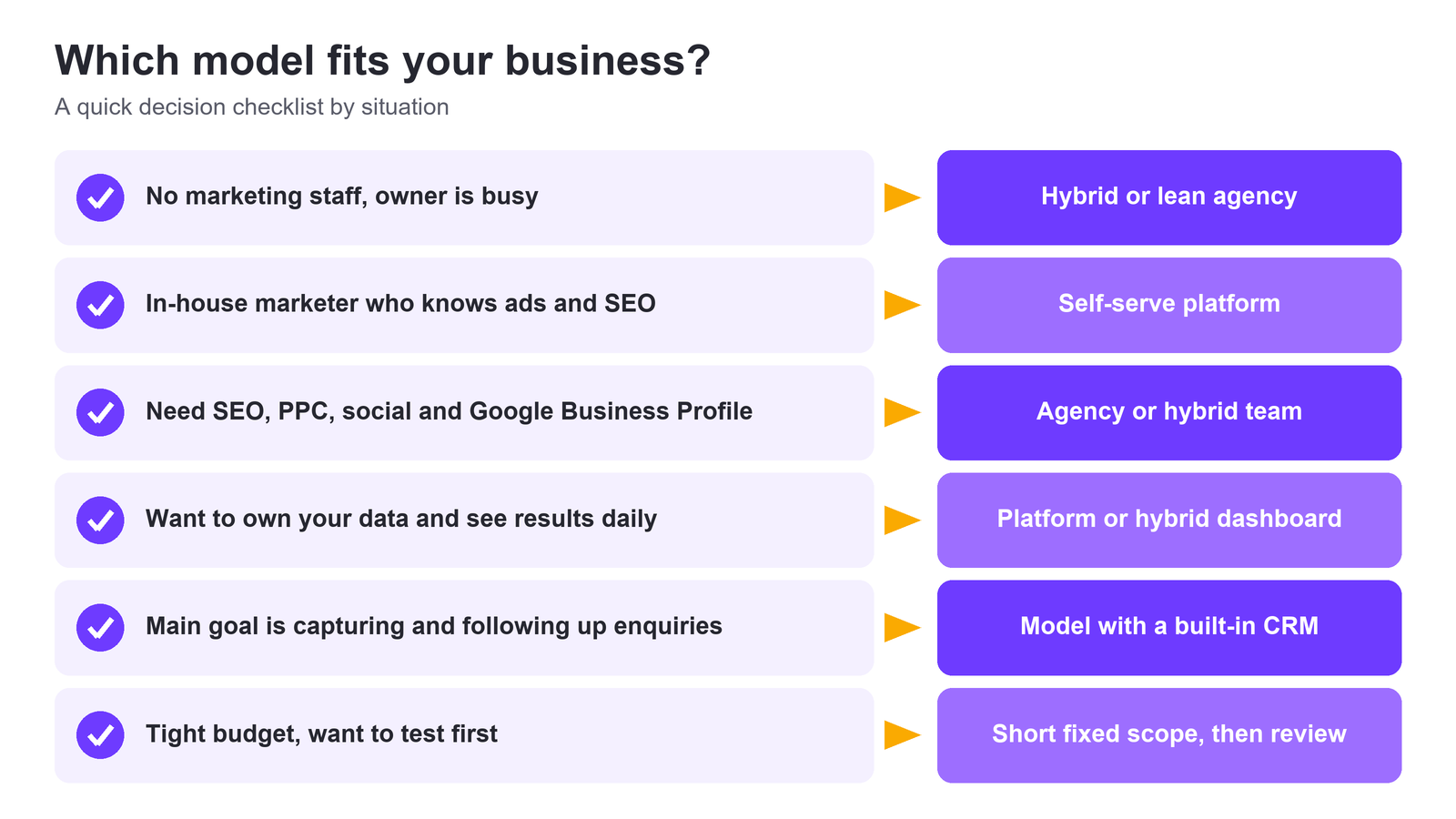
Which model suits your business? A decision checklist
Most businesses recognise themselves in one or two of these situations.
- You are a sole trader or micro business with no marketing staff. A hybrid model or a lean agency arrangement is usually safer than a self-serve tool you will not have time to run.
- You have an in-house marketer who knows ads and SEO. A self-serve platform can extend their reach, as long as someone owns reporting and data protection.
- You need a wide mix of channels, such as SEO, PPC, social and Google Business Profile. An agency or hybrid team brings the range of skills; compare the full range of marketing services Irish firms buy against what each provider actually delivers.
- You want to own your data and see results daily. Favour a platform or hybrid with a unified dashboard and accounts in your business's name.
- You are searching for an ai marketing agency near me because you want face-to-face meetings. Ask whether the provider will meet in person and how often, since many now work remotely across the country.
- Your priority is capturing and following up enquiries. Make sure the model includes tools that capture and organise incoming leads, not just traffic.
- Budget is tight and you want to test first. Start with a defined three-month scope, agree success measures upfront and review before committing further.
Can Local Enterprise Office supports help fund the decision?
Funding can change the maths, particularly for the software side of the decision. The Grow Digital Voucher from Local Enterprise Offices offers grant aid of 50% of eligible costs, with a minimum of €500 and a maximum of €5,000 per application, for small enterprises with between 1 and 50 paid employees. According to the Department of Enterprise announcement, the Grow Digital Voucher replaced the previous Trading Online Voucher.
There are conditions. The LEO page states that applicants must have completed a Digital for Business project within the previous two years, and eligible costs are mainly new, off-the-shelf software subscriptions (for up to one year) plus training and IT configuration. CRM software is listed as an eligible example; bespoke website development is not.
Agency retainers and ad spend are not listed as eligible costs, so the voucher is more likely to help with the software side of a platform or hybrid model. Speak to your LEO before you sign or pay anything, and confirm current terms on localenterprise.ie.
Conclusion
There is no single best model, only the one that fits your time, skills and appetite for control. A traditional agency suits businesses that want to hand over the work entirely, a self-serve platform suits teams with marketing expertise in-house, and a hybrid platform plus team suits owner-managed SMEs that want AI-driven speed, clear data ownership and people to call when something needs judgement.
If you are shortlisting an AI marketing agency Ireland has to offer and want an honest view of which model fits your business, talk to the NexAI Solutions team and book a free consultation.
Frequently Asked Questions
What is an AI digital marketing agency?
It is a marketing provider that uses artificial intelligence to plan, create, run or optimise campaigns. Some are traditional agencies using AI tools behind the scenes, while others combine a software platform with a managed team.
Is an AI marketing platform cheaper than an agency?
The subscription is often lower than an agency retainer, but you need to add the time someone in your business spends running it. Compare the total cost of ownership, not just the monthly fee.
What does an ai digital agency do differently from a traditional agency?
An AI-first provider automates repetitive tasks such as content drafts, scheduled publishing, website checks and reporting, so people focus on strategy. A traditional agency may use some AI tools but relies mainly on manual effort.
Do I need a data processing agreement with my marketing provider?
If the provider handles personal data on your behalf, such as customer emails or enquiry details, GDPR generally requires a written contract between controller and processor. The Data Protection Commission publishes guidance on what that contract must cover. Ask for the agreement before any data is shared.
Can I use the Grow Digital Voucher for AI marketing?
The voucher covers 50% of eligible costs up to €5,000, mainly new off-the-shelf software subscriptions plus training and configuration. You need to have completed a Digital for Business project in the previous two years. Talk to your Local Enterprise Office before spending, as agency fees and ad spend are not listed as eligible costs.
Should I choose an AI marketing agency near me?
Location matters less than it used to, since most marketing work happens online. If face-to-face meetings matter to you, ask how often the provider will meet in person, but focus first on whether the model fits your skills, budget and data needs.